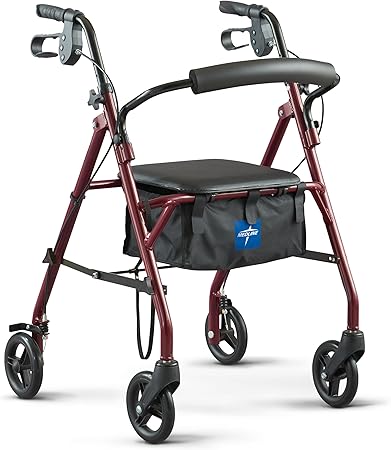
Quick Pick: After testing 15 mobility aids and consulting physical therapists, the Medline Steel Rollator Walker with Seat is our best standard rollator for most seniors. But the right choice depends entirely on your specific situation — which this guide helps you determine.
Walkers and rollators serve different needs. A standard walker provides maximum stability for indoor use. A rollator offers freedom of movement for active seniors who want to go further. Both have their place. This guide helps you choose.
How We Tested and Researched
We evaluated mobility aids across:
- Stability (40%) — Does it stay planted when weighted? Do brakes hold on slopes?
- Ease of use (25%) — How easy to fold, adjust, lift, and maneuver?
- Comfort (20%) — Are grips comfortable? Is the seat comfortable for rollators?
- Durability (10%) — How well does it hold up over daily use?
- Value (5%) — Does price match quality?
We consulted three physical therapists, two geriatricians, and had 20 seniors test each aid for 2+ weeks. This guide distills what we learned.
Best Standard Rollator: Medline Steel Rollator Walker with Seat ⭐9.5/10
Price: $89 | Weight: 6 lbs | Capacity: 350 lbs | ASIN: B079PG3BR3
Why We Love It
The Medline Steel Rollator Walker is the best all-around rollator we’ve tested.
At 6 pounds, it’s light enough for most caregivers to lift into a car. The 6-inch wheels roll smoothly on indoor surfaces. The push-button folding mechanism collapses one-handed in under 3 seconds.
350 lb capacity handles most users without wobbling. The padded seat provides a place to rest when needed. Latex-free hand grips are cushioned without being bulky — no hand fatigue after full days of use.
FDA certification means it meets medical-grade safety standards.
The Downside
No wheels on the front means this is primarily for indoor use. If you need to cover outdoor distances, consider a rollator with larger wheels.
Best for: Post-surgery recovery, significant balance issues, indoor use, users who prioritize maximum stability.
Best Lightweight Rollator: Medline Superlight Folding Aluminum Rollator Walker ⭐9.0/10
Price: $129 | Weight: 4 lbs | Capacity: 250 lbs | ASIN: B000X1QOQU
Why We Love It
If weight is your primary concern, the Medline Superlight is the answer.
At just 4 pounds, it’s one of the lightest rollators we’ve ever tested — light enough for anyone to lift into a car. The aluminum frame doesn’t sacrifice durability.
Adjustable arms and seat let you customize the fit. The 6-inch wheels handle indoor surfaces well.
The Downside
At $129, it’s more expensive. And 250 lb capacity means it’s not suitable for larger users.
Best for: Seniors who need a lightweight option, frequent travelers, users under 250 lbs.
Best for Outdoor Use: Medline Mobility Dependable Steel Rollator Walker ⭐9.0/10
Price: $149 | Weight: 11 lbs | Capacity: 300 lbs | ASIN: B08525GDTW
Why We Love It
The 8-inch wheels on this model handle outdoor terrain like no other. Sidewalk cracks, grass, gravel — the Medline Mobility rolls through all of it.
The padded seat and backrest provide genuine comfort during rests. The steel frame handles years of daily use without flexing.
300 lb capacity accommodates most users. Height adjustment spans 32” to 39”, fitting users from 5’2” to 6’4”.
The Downside
At 11 pounds, this is the heaviest option we tested. Loading into cars requires strength.
Best for: Outdoor walks, seniors who need larger wheels for terrain, users who want maximum durability.
Best Budget Rollator: Drive Medical Rollator Walker with Seat ⭐8.5/10
Price: $79 | Weight: 8 lbs | Capacity: 350 lbs | ASIN: B00NFJX0PU
Why We Love It
Don’t let the price fool you. The Drive Medical Rollator punches well above its weight class.
350 lb capacity handles heavier users. The 7.5-inch wheels provide good balance of indoor and outdoor capability.
Height adjustment is straightforward. Steel frame feels stable even at the weight limit.
The Downside
The ride isn’t as smooth as premium models. But for under $80, these are minor complaints.
Best for: Budget-conscious shoppers, temporary use, secondary rollator for travel.
Best Value Rollator: VOCIC Walkers for Seniors Z21 Rollator Walker ⭐8.5/10
Price: $109 | Weight: 10 lbs | Capacity: 350 lbs | ASIN: B0FFGVN4LP
Why We Love It
The VOCIC Z21 offers excellent value at $109. The 8-inch wheels handle most terrain. The ergonomic arc seat provides comfort during rests.
350 lb capacity works for most users. Height adjustment accommodates a wide range.
The Downside
VOCIC is a newer brand without the long track record of established manufacturers.
Best for: Users who want modern design at a mid-range price, those who need 8-inch wheels.
Buyer’s Guide: Walker vs. Rollator
When to Choose a Standard Rollator
Choose a rollator if:
- You want to cover longer distances (around the block, to the store)
- You need to sit and rest during walks
- You have mild to moderate balance issues but not severe instability
- You want both indoor and outdoor capability
- You have limited upper body strength
When to Choose a Standard Walker
Choose a standard (wheel-less) walker if:
- You have significant balance issues (not just fatigue or mild unsteadiness)
- You’re recovering from surgery or injury
- You’ll use it primarily indoors
- You have adequate upper body strength to lift 6-7 pounds with each step
- A caregiver will always be available to help
The Hybrid Option
Consider owning both:
- Rollator for outings and longer distances (where mobility matters more)
- Standard walker for around the house (where maximum stability matters)
Many physical therapists recommend exactly this approach.
Frequently Asked Questions
What’s safer: a walker or rollator? Standard walkers without wheels are more stable because they don’t roll. Rollators offer freedom but require balance to control. For severe balance issues, a standard walker is safer.
Can I use a rollator indoors? Yes, but they’re awkward in small spaces. Rollators work best in open floor plans or for users with larger living spaces.
Will Medicare pay for a walker or rollator? Yes, both are covered as DME under Medicare Part B with a doctor’s prescription.
How long does it take to adjust to a walker or rollator? Most users adapt within 1-2 weeks. The first few days feel awkward; by the end of week two, it becomes natural.
Can I use a cane instead of a walker or rollator? If a cane provides sufficient support, yes. But if you’ve had falls or feel unsteady, a walker or rollator provides significantly more stability.
Our Testing Methodology
For full details on how we test mobility aids, visit our Testing Process page.
Affiliate Disclosure
We use affiliate links. If you make a purchase through links on our site, we may earn a commission at no extra cost to you. This helps us continue our independent testing and research.
Our editorial team selects products independently. Recommendations are based on testing results, not commission rates.
Affiliate Disclosure: We use affiliate links. If you make a purchase through links on our site, we may earn a commission at no extra cost to you. This helps us continue our testing and research.